Call:
 Send Inquiry
 Send Inquiry
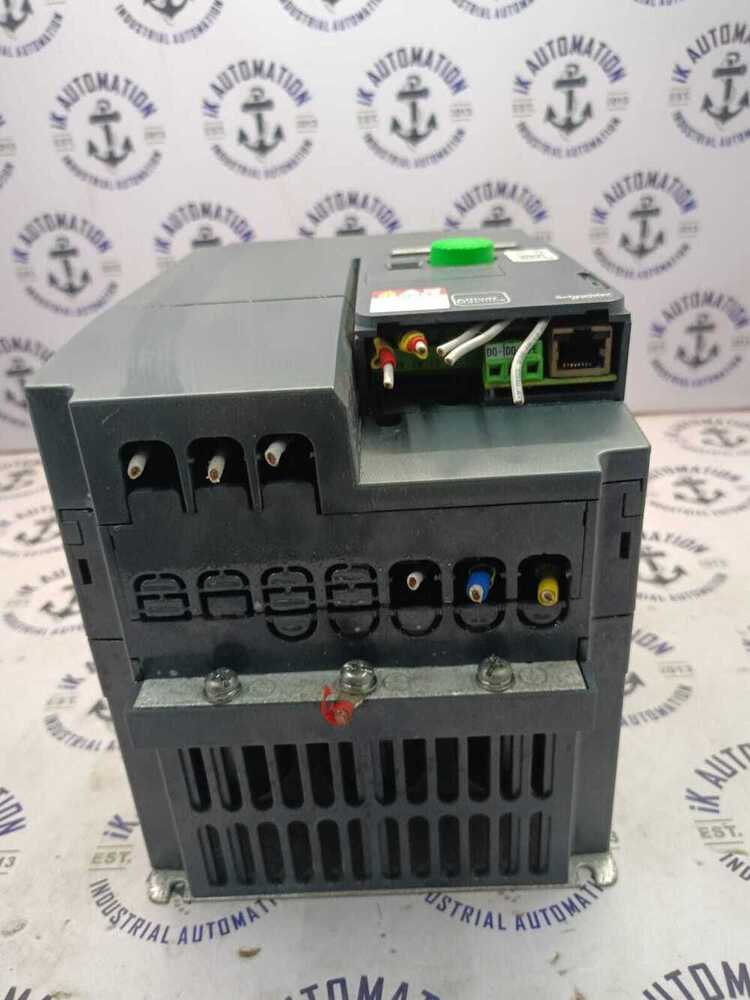
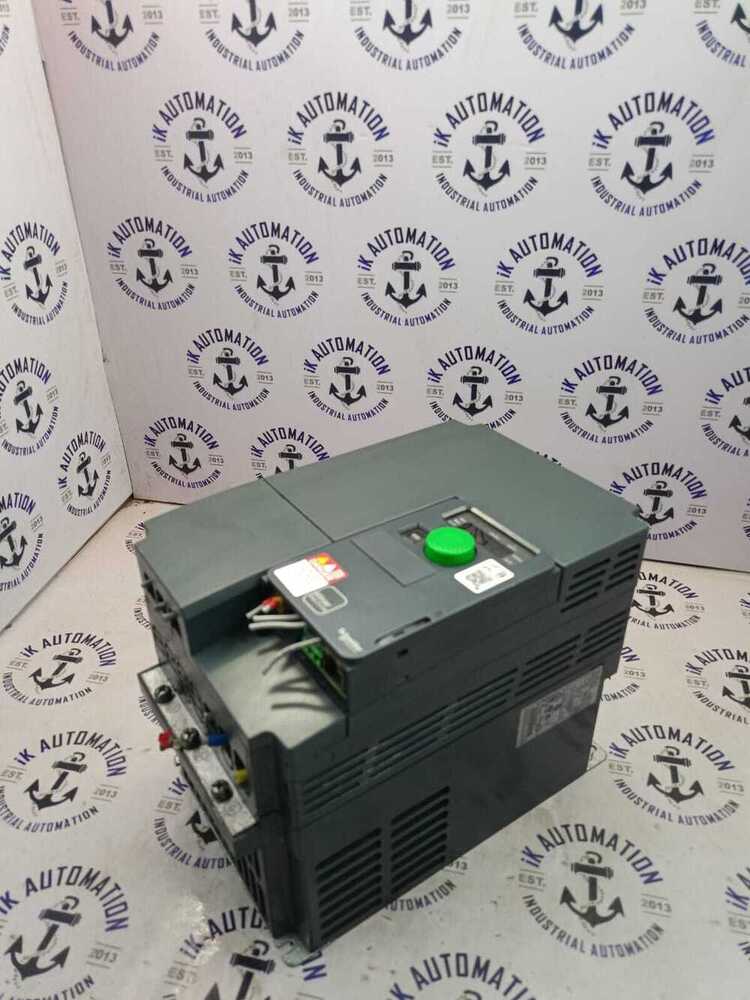
SCHNEIDER ATV320U55N4C
Price 1213 INR/ Piece
MOQ : 1 Piece
SCHNEIDER ATV320U55N4C Specification
- Surface Finish
- Matte
- Humidity %
- 5% to 95% Non-condensing
- Mounting Type
- Wall Mount
- Power Factor
- 0.98 (typical)
- Shape
- Rectangular
- Connector Type
- Screw Terminal
- Overheating Protection
- Yes, with integrated thermal protection
- Insulation Material
- High-Grade Engineering Plastic
- IP Rating
- IP20
- Operating Temperature
- -10C to +50C
- Efficiency
- Up to 97%
- Feature
- Integrated Display, Communication Ports, Programmable Functions
- Product Type
- Variable Frequency Drive (VFD)
- Application
- Industrial Motor Control
- Protection Level
- Integrated EMC Filter, Overvoltage, Undervoltage, Overload and Short Circuit Protection
- Frequency (MHz)
- 50/60 Hz
- Rated Voltage
- 380-500 VAC
- Energy Consumption
- Optimized motor control reduces energy consumption
- Output Type
- 3-phase AC Motor Output
- Color
- Dark Grey
- Dimension (L*W*H)
- 250 x 150 x 200 mm
- Weight
- 5.5 kg
- Phase
- Three Phase
- Size
- Frame Size 3
- Input Voltage
- 380-500 VAC
- Connection Type
- Screw Terminal
- No Of Poles
- 3
- Material
- Plastic and Metal
- Braking Unit
- Integrated
- Motor Control Type
- Sensorless Vector Control, V/F Control
- Programming Method
- Keypad or Remote via Software
- Altitude
- < 1000 m without derating
- Power Rating
- 5.5 kW / 7.5 HP
- Relay Outputs
- 2 relay outputs
- Standards Complied
- IEC/EN 61800-5-1, IEC/EN 61800-3
- Digital Input
- 6 programmable inputs
- Display
- 7-segment LED with keypad
- Model Number
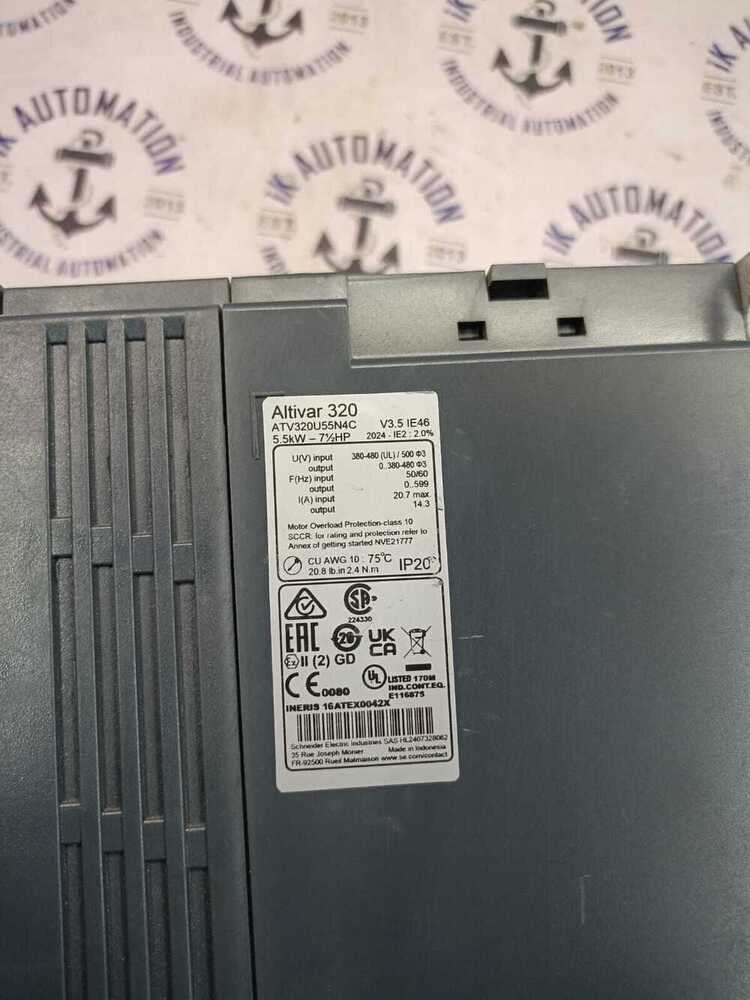
- ATV320U55N4C
- Communication Protocols
- Modbus, CANOpen
- Analog Input
- 2 x 0-10 V/4-20 mA
SCHNEIDER ATV320U55N4C Trade Information
- Minimum Order Quantity
- 1 Piece
- Payment Terms
- Paypal, Cash Against Delivery (CAD), Cash on Delivery (COD), Cash Advance (CA), Cash in Advance (CID), Cheque, Days after Acceptance (DA), Delivery Point (DP), Letter of Credit at Sight (Sight L/C), Telegraphic Transfer (T/T)
- Supply Ability
- 100 Pieces Per Day
- Delivery Time
- 1 Days
- Sample Available
- Yes
- Sample Policy
- Contact us for information regarding our sample policy
- Packaging Details
- AS PER CAUSTOMER
- Main Export Market(s)
- Asia, Australia, Central America, North America, South America, Eastern Europe, Western Europe, Middle East, Africa
- Main Domestic Market
- All India
- Certifications
- USED SCHNEIDER ATV320U55N4C
SCHNEIDER ATV320U55N4C About
USED SCHNEIDER ATV320U55N4C
Main Specifications
| Parameter | Specification |
|---|---|
| Model | ATV320U55N4C |
| Series | Altivar Machine ATV320 |
| Type | Variable Speed Drive / VFD |
| Motor Power | 5.5 kW / 7.5 HP |
| Input Voltage | 380500 V AC |
| Input | 3 Phase |
| Output Current | 14.3 A |
| Motor Type | Asynchronous & Synchronous |
| Frequency | 50/60 Hz input |
| Protection | IP20 |
| EMC Filter | Integrated Class C2 |
| Cooling | Fan cooled |
| Mounting | Compact / wall mount |
| Communication | Modbus, CANopen; optional Ethernet/IP, PROFINET, EtherCAT, Profibus, etc. |
| Safety | STO (Safe Torque Off) |
Versatile Industrial Motor Control
The ATV320U55N4C offers dynamic sensorless vector control and V/F control, suitable for various industrial applications. With up to six programmable digital inputs and two analog inputs, it provides flexible integration with automated systems. Its three-phase output supports smooth motor operation, and the integrated braking unit ensures precise stopping performance.
Efficient Operation and Energy Savings
Designed with energy optimization in mind, the ATV320U55N4C enhances motor efficiency, reducing power consumption and costs. The device features a high typical power factor of 0.98, and operates efficiently even at high ambient temperatures, making it ideal for energy-conscious industrial operations.
Advanced Protection and Compliance
Equipped with an integrated EMC filter, overvoltage, undervoltage, overload, overheating, and short-circuit protections, this unit ensures safety and reliability. Adhering to IEC/EN standards, it delivers peace of mind for operators, distributors, and service providers working in stringent industries throughout Indonesia.
FAQ's of SCHNEIDER ATV320U55N4C:
Q: How is the SCHNEIDER ATV320U55N4C typically used in industrial settings?
A: The ATV320U55N4C is widely used for controlling the speed and torque of three-phase AC motors in sectors such as manufacturing, processing plants, and conveyor systems. Its flexible control modes and programmable functions make it ideal for machine automation and energy management applications.Q: What communication protocols does this drive support for remote operation?
A: This model supports both Modbus and CANOpen communication protocols, enabling monitoring and remote control via industrial networks. Users can program and manage the drive through these connections, ensuring seamless integration with existing automation systems.Q: When should the integrated thermal and overload protections activate?
A: Integrated thermal and overload protections automatically activate when the drive or connected motor exceeds safe temperature or load thresholds. This timely intervention helps prevent equipment damage and ensures long-term operational reliability.Q: Where can this variable speed drive be installed?
A: The ATV320U55N4C is designed for wall mounting in industrial environments with ambient temperatures ranging from -10C to +50C. It is suitable for installation at altitudes below 1000 meters without derating, making it appropriate for a wide range of locations across Indonesia.Q: What is the process for programming the drive's functions?
A: Programming can be performed via the integrated 7-segment LED keypad or remotely using configuration software through the supported communication ports. The intuitive interface allows users to set parameters, monitor operation, and adjust performance according to application requirements.Q: How does this device contribute to energy efficiency?
A: By employing optimized motor control algorithms, the ATV320U55N4C reduces unnecessary energy consumption, achieving operational efficiency rates up to 97%. This leads to lower utility costs and supports sustainable industrial practices.Q: What are the benefits of its integrated EMC filter and multi-level protections?
A: The integrated EMC filter minimizes electrical noise, ensuring compliance with industrial standards and protecting nearby equipment. The drive's array of protection features shields both the drive and connected motors from electrical faults, enhancing system safety.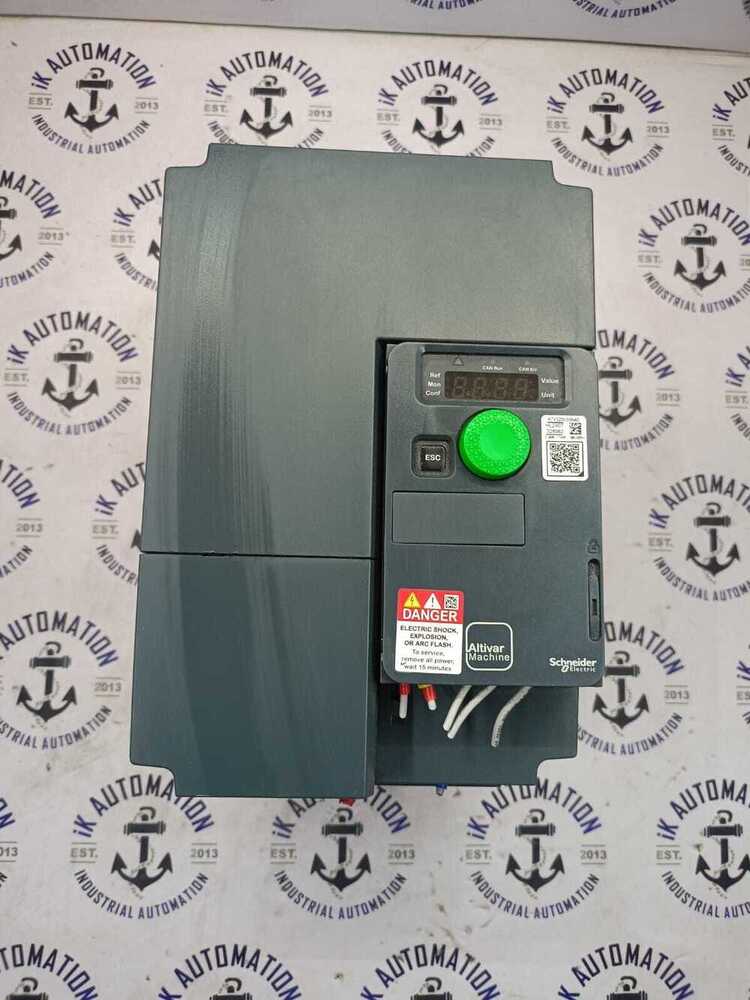
Tell us about your requirement

Price:
Quantity
Select Unit
- 50
- 100
- 200
- 250
- 500
- 1000+
Additional detail
Mobile number
Email

More Products in SCHNEIDER AC DRIVE Category
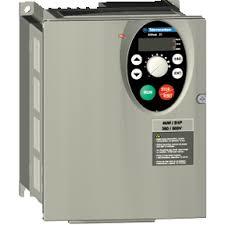
SCHNEIDER ATV31HU40N4A
Price 15000 INR / Piece
Minimum Order Quantity : 1 Piece
Phase : Three Phase
Material : Plastic & Metal
Overheating Protection : Other, Available
Connector Type : Terminal Block
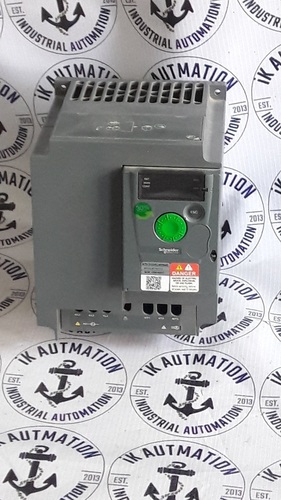
SCHNEIDER ATV310HU40N4E
Price 15000 INR / Piece
Minimum Order Quantity : 1 Piece
Phase : Three Phase
Material : Plastic, Metal
Overheating Protection : YES
Connector Type : Terminal Block
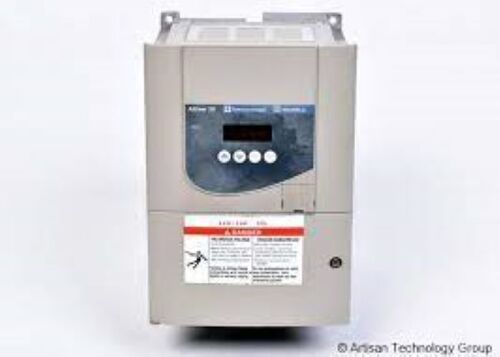
SCHNEIDER ATV28HU09M2
Price 9000 INR / Piece
Minimum Order Quantity : 1 Piece
Phase : Three Phase
Material : Metal, Plastic
Overheating Protection : YES
Connector Type : Screw Terminal
Schneider Atv31hu11m2a
Price 10500 INR / Piece
Minimum Order Quantity : 1 Piece
Phase : Three Phase
Material : Plastic & Metal
Overheating Protection : YES
Connector Type : Screw Type

Contact Details
IK AUTOMATION
GST : 24ECXPP8360K1ZN
- Vip - Plot No.328-329-330/h-1, Near Dilkhus Pan, Motitalav- Kumbharwada Road,Bhavnagar - 364001, Gujarat, India
- Phone :91--8000027799
 Send Inquiry
Developed and Managed by Infocom Network Private Limited.
